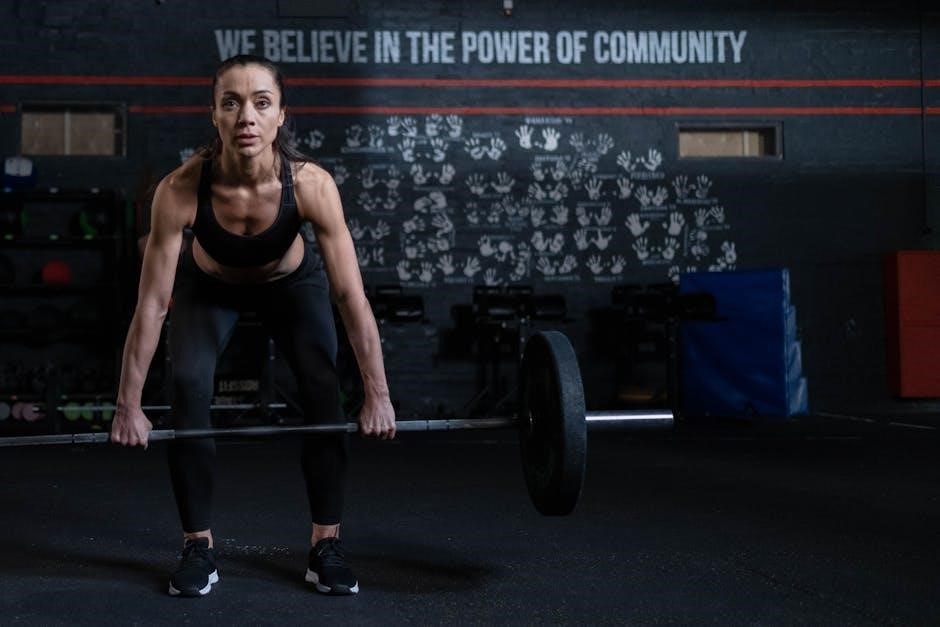
Deadlift Program PDF: A Comprehensive Guide
Discover expertly crafted deadlift programs in PDF format, designed to elevate your strength and technique, incorporating dumbbell Romanian deadlifts for optimal results.
Embarking on a structured deadlift program is a pivotal step towards maximizing strength gains and minimizing injury risk. Utilizing a deadlift program PDF offers a convenient and organized approach to training this foundational exercise. These PDFs typically outline progressive overload schemes, detailing how to incrementally increase weight, volume, or intensity over time.
A well-designed program considers individual strength levels, experience, and goals. Many PDFs incorporate variations like the conventional, sumo, Romanian, and trap bar deadlifts, each targeting slightly different muscle groups. The accessibility of these resources allows for consistent tracking and adjustments, crucial for long-term progress. Furthermore, a PDF format enables easy portability and offline access during workouts, ensuring your plan is always at hand.
Why Use a Deadlift Program?
Employing a dedicated deadlift program PDF streamlines your training, moving beyond random workouts to a focused, progressive plan. These programs are designed to build full-body strength, particularly targeting the posterior chain – back, glutes, and hamstrings. A structured approach minimizes plateaus by systematically challenging your muscles.
PDF programs often include detailed instructions and form cues, reducing the risk of injury. They provide a clear roadmap for progression, eliminating guesswork and ensuring consistent effort. Accessing a PDF allows for convenient tracking of your lifts and adjustments based on performance. Ultimately, a program maximizes efficiency, delivering optimal results in a safe and effective manner.
Understanding Deadlift Variations
A comprehensive deadlift program PDF will often incorporate various deadlift styles to target different muscle groups and address individual biomechanics. Conventional deadlifts are the standard, emphasizing overall strength. Sumo deadlifts utilize a wider stance, reducing range of motion and engaging the quads more.
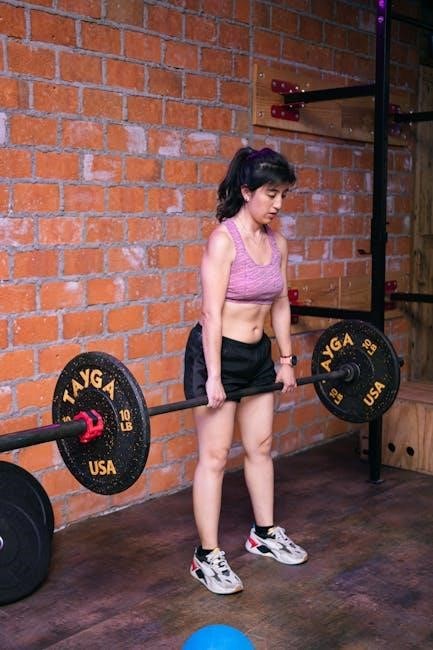
Romanian Deadlifts (RDLs) focus on hamstring and glute development, promoting hip hinge mechanics. Finally, Trap Bar deadlifts offer a more beginner-friendly option, reducing stress on the lower back. Understanding these variations allows for a well-rounded program, preventing imbalances and maximizing strength gains.
Conventional Deadlift

A solid deadlift program PDF will invariably feature the conventional deadlift as a cornerstone exercise. This variation involves a double overhand grip (or mixed grip for heavier weights) and a hip-width stance. Lifters pull the barbell from the floor, maintaining a straight back and engaging the entire posterior chain – hamstrings, glutes, and lower back.
Effective programs emphasize proper form over sheer weight, building a strong foundation. PDF guides often detail progressive overload strategies for this lift, ensuring consistent gains. Mastering the conventional deadlift is crucial for overall strength and power development.
Sumo Deadlift

A comprehensive deadlift program PDF frequently includes the sumo deadlift as a valuable alternative. This variation utilizes a wider stance, with the lifter positioned inside the barbell. The arms remain inside the legs during the pull, reducing the range of motion compared to the conventional style.
Many PDF resources highlight the sumo deadlift’s benefits for individuals with longer torsos or limited hip mobility. Well-designed programs will incorporate both conventional and sumo variations to address different strengths and weaknesses, promoting balanced development and preventing plateaus.
Romanian Deadlift (RDL)
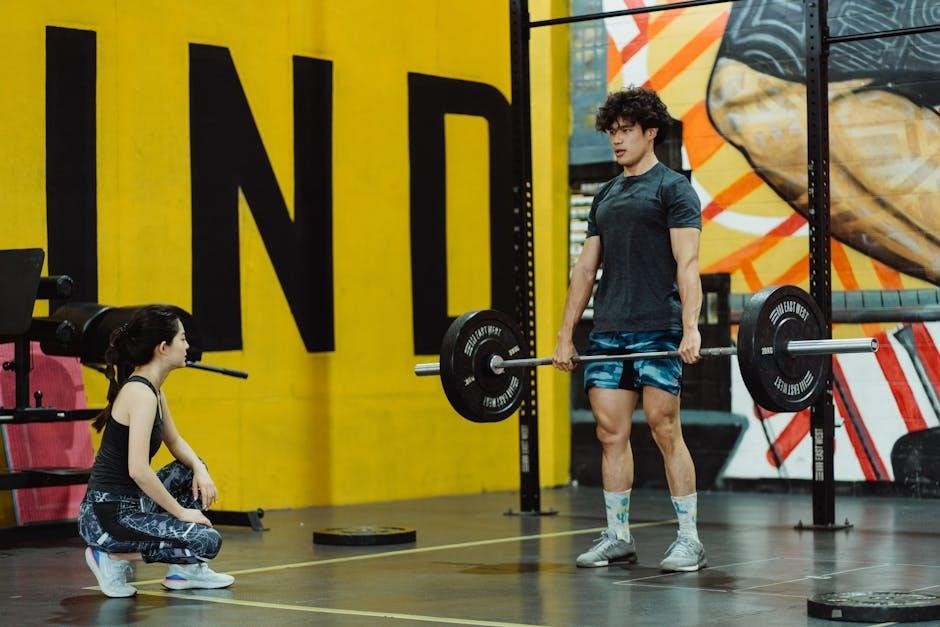
A quality deadlift program PDF will invariably feature the Romanian Deadlift (RDL) as a key accessory exercise. Unlike a traditional deadlift, the RDL focuses on hamstring and glute development, emphasizing a hip hinge movement pattern. The barbell remains close to the legs throughout the entire range of motion, maintaining a slight bend in the knees.
PDF guides often demonstrate how RDLs improve posterior chain strength, crucial for overall athletic performance and injury prevention. Effective programs integrate RDLs to enhance deadlift technique and build a solid foundation for heavier lifts, often utilizing dumbbell variations.
Trap Bar Deadlift
Comprehensive deadlift program PDFs frequently include the Trap Bar Deadlift as a valuable variation. Utilizing a hexagonal-shaped bar, this lift allows for a more upright torso position, reducing stress on the lower back compared to conventional styles. This makes it an excellent option for beginners or individuals with back sensitivities.
Well-structured PDFs will detail how the Trap Bar Deadlift promotes overall strength gains, particularly in the quads and glutes. Effective programs often incorporate it as a supplemental exercise to the conventional deadlift, offering a different stimulus and preventing plateaus.

Assessing Your Current Strength Level
Before diving into any deadlift program PDF, accurately gauging your current strength is crucial for safety and progress. Quality PDFs emphasize starting at an appropriate weight to avoid injury and build a solid foundation. This involves honestly evaluating your one-rep max (1RM) or, if a beginner, determining a weight you can lift with good form for multiple repetitions.
Detailed program PDFs often provide strength standards categorized by experience level – beginner, intermediate, and advanced – offering benchmarks to help you identify your starting point. Proper assessment ensures the program’s intensity and volume are tailored to your capabilities.
Beginner Deadlift Standards

For individuals new to deadlifting, a beginner deadlift standard, as often outlined in introductory program PDFs, focuses on mastering technique before increasing weight. Generally, a beginner should aim to deadlift their bodyweight for 5 repetitions with good form. Many PDFs suggest starting with just the bar (45lbs/20kg) or very light weights.

Prioritize learning the proper setup, maintaining a straight back, and engaging the correct muscle groups. Progressive overload, a key principle in most deadlift PDFs, means gradually increasing weight only when form remains impeccable. Focus on consistency and building a strong neural pathway.
Intermediate Deadlift Standards
Intermediate lifters, often guided by more detailed deadlift program PDFs, should demonstrate consistent strength gains and refined technique. Typically, an intermediate lifter can deadlift 1.5 to 2 times their bodyweight for 3-5 repetitions. These PDFs frequently incorporate variations like Romanian deadlifts to address weaknesses.
Program design at this level, as detailed in many downloadable PDFs, emphasizes periodization – varying intensity and volume over time. Expect to see accessory work included to strengthen supporting muscles. Focus shifts towards improving maximal strength and addressing sticking points, often with specific cues found within the PDF guides.
Advanced Deadlift Standards
Advanced lifters, utilizing highly specialized deadlift program PDFs, exhibit exceptional strength and technique mastery. They routinely deadlift 2.5+ times their bodyweight for repetitions of 1-3, showcasing elite power. These PDFs often detail complex periodization schemes and advanced techniques.
Program customization is key at this level, with PDFs serving as blueprints for individualized training. Expect to see frequent deload weeks and meticulous tracking of performance metrics. Advanced programs prioritize maximizing potential, often incorporating variations and addressing subtle biomechanical inefficiencies, all detailed within the PDF resources.
Key Principles of Deadlift Program Design
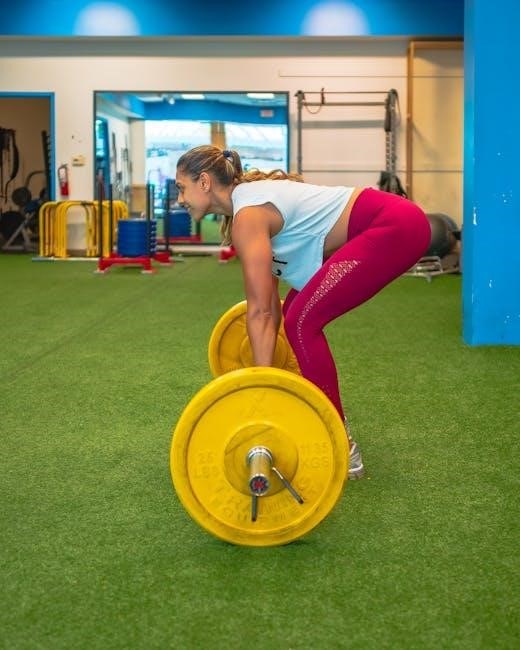
Effective deadlift program PDFs center around core principles for optimal gains. Progressive overload is paramount – gradually increasing weight, reps, or sets over time, as detailed in the PDF. Volume and intensity must be balanced; PDFs outline appropriate ranges based on experience level. Strategic programming considers both.
Recovery is crucial; PDFs emphasize adequate rest and deload weeks to prevent overtraining; Frequency depends on individual needs and program goals, clearly outlined within the PDF structure. Successful programs, found in PDF format, prioritize these elements for sustainable strength development and injury prevention.
Progressive Overload
Deadlift program PDFs consistently emphasize progressive overload as the cornerstone of strength gains. This involves systematically increasing the demands placed on your muscles over time. PDFs detail methods like adding weight incrementally – even 1-2.5kg per session – or increasing repetitions with the same weight;
Another approach, outlined in many PDFs, is to increase the number of sets performed. Properly structured PDFs will also incorporate deload weeks to allow for recovery and prevent plateaus. Consistent application of progressive overload, guided by a well-designed PDF, is vital for continuous improvement in your deadlift.
Volume and Intensity
Deadlift program PDFs carefully balance volume – the total amount of work performed – and intensity, referring to the weight lifted relative to your maximum. Many PDFs advocate for lower intensity (60-70% of 1RM) with higher volume during accumulation phases, building work capacity.
Conversely, peaking phases, detailed in advanced PDFs, prioritize higher intensity (85-100% of 1RM) with reduced volume. Effective PDFs will provide guidelines for adjusting these variables based on your experience level and goals. Understanding this interplay, as presented in quality PDFs, is crucial for maximizing strength gains and minimizing injury risk.
Frequency and Recovery
Comprehensive deadlift program PDFs address training frequency, typically recommending 1-3 deadlift sessions per week, depending on volume and intensity. Beginner PDFs often suggest lower frequency to allow for adequate recovery. Advanced programs might incorporate variations like Romanian deadlifts on separate days.
Crucially, these PDFs emphasize the importance of recovery – sleep, nutrition, and active recovery – for optimal results. Quality PDFs will detail deload weeks, reducing volume to prevent overtraining. Prioritizing recovery, as outlined in these resources, is as vital as the lifting itself for long-term progress and injury prevention.
Sample Deadlift Programs (PDF Focus)
Deadlift program PDFs frequently offer structured plans for various levels. Beginner PDFs typically feature 8-week programs focusing on form and building a strength base, utilizing lower weights and higher repetitions. Intermediate PDFs present 12-week plans, increasing weight and introducing variations like Romanian deadlifts.
Advanced PDFs often include 16-week programs with periodization, peaking strategies, and complex exercises. These resources detail sets, reps, and rest times, providing a clear roadmap. Many PDFs emphasize progressive overload, ensuring consistent gains and adaptation throughout the program’s duration.
Beginner 8-Week Deadlift Program
This 8-week PDF program prioritizes foundational strength and proper technique. Weeks 1-2 focus on mastering the hip hinge movement with lighter weights, performing 3 sets of 8-12 repetitions. Weeks 3-4 introduce conventional deadlifts with gradually increasing weight, maintaining 3 sets of 5-8 reps.
Weeks 5-6 incorporate Romanian deadlifts to build hamstring strength, 3 sets of 10-15 reps. Weeks 7-8 continue progressive overload, adding weight while monitoring form closely. Rest periods are 60-90 seconds between sets. Warm-up includes dynamic stretching and light cardio before each session.
Intermediate 12-Week Deadlift Program
This 12-week PDF program builds upon a solid foundation, incorporating variations and increased intensity. Weeks 1-4 focus on conventional and sumo deadlift variations, alternating weekly with 3 sets of 5-6 reps. Weeks 5-8 introduce accessory work like good mornings and glute-ham raises, 3 sets of 8-12 reps.
Weeks 9-12 emphasize peaking for a 1RM test, utilizing deload weeks and heavier sets of 3-5 reps. Rest periods extend to 90-120 seconds. Warm-up includes mobility work and progressively heavier warm-up sets. Focus is on refining technique and maximizing strength gains.
Advanced 16-Week Deadlift Program
This demanding 16-week PDF program is for experienced lifters seeking substantial strength gains. Weeks 1-4 utilize a rotating block periodization, cycling between conventional, sumo, and trap bar deadlifts – 4 sets of 4-6 reps. Weeks 5-8 introduce accommodating resistance (bands/chains) and speed work, focusing on explosive power.
Weeks 9-12 incorporate heavier singles and doubles, peaking for competition or a 1RM test. Weeks 13-16 are dedicated to a deload and transition phase, maintaining strength while addressing weaknesses. Expect long rest periods and meticulous attention to form.
Accessing and Utilizing Deadlift Program PDFs
Numerous online resources offer downloadable deadlift programs in PDF format, catering to all levels. Reputable fitness websites, strength coaching platforms, and even some powerlifting organizations provide free or premium options. Always prioritize sources with qualified trainers and positive user reviews.
When utilizing a PDF program, carefully read the instructions and understand the exercise variations. Don’t hesitate to modify the program based on your individual needs and recovery capacity. Tracking your progress is crucial; record your sets, reps, and weight lifted to monitor improvements and adjust accordingly.
Reliable Sources for Deadlift PDFs
Finding trustworthy deadlift programs requires careful selection of sources. Websites like StrongLifts, Juggernaut Training Systems, and Renaissance Periodization frequently offer well-structured PDF programs. Look for credentials – coaches with certifications (CSCS, USAW) add credibility. Powerlifting-specific sites often provide programs geared towards competition preparation.
Consider exploring platforms like PDFWorkout or similar fitness resource aggregators, but always vet the program’s origin. Beware of overly simplistic or “quick fix” programs; sustainable progress demands a balanced approach. Prioritize resources that emphasize proper form and progressive overload for safe and effective training.
Customizing PDF Programs to Your Needs
Downloaded deadlift PDFs are excellent starting points, but personalization is key. Assess your individual weaknesses and adjust volume or intensity accordingly. If a program includes accessory work you dislike, substitute exercises targeting the same muscle groups. Consider your recovery capacity; reduce frequency if needed.
Don’t be afraid to modify rep schemes or rest periods to suit your preferences. Track your progress meticulously and make adjustments based on performance. Remember that a program is a tool, not a rigid rulebook. Prioritize listening to your body and adapting the PDF to optimize your results and prevent injury.
Common Deadlift Mistakes and How to Avoid Them
Many lifters, even with a deadlift program PDF, fall into common pitfalls. Rounding the back is prevalent; maintain a neutral spine throughout the lift, bracing your core. Hitching the bar – using legs to ‘bounce’ it up – reduces effectiveness and increases injury risk; focus on controlled, explosive power.
Improper setup, like a weak grip or incorrect foot placement, compromises form. Review instructional videos and practice with lighter weights. Prioritize technique over ego; a slightly lower weight with perfect form is far superior. Consistent self-assessment and mindful lifting are crucial for safe and effective progress.

Rounding the Back
A rounded back during a deadlift, even when following a detailed deadlift program PDF, is a significant injury risk. This occurs when the natural spinal curve collapses, placing immense stress on the discs. To avoid this, actively engage your lats, pulling your shoulders back and down.
Maintain a tight core throughout the entire lift, imagining bracing for a punch. Focus on keeping your chest up and eyes forward. Practice with lighter weights to master the correct form before increasing the load. Remember, a neutral spine is paramount for safe and effective deadlifting.
Hitching the Bar
Hitching, or resting the bar on your thighs during the ascent in a deadlift program PDF, compromises form and limits muscle engagement. It transforms the exercise into a partial range of motion movement, hindering full strength development. Avoid using momentum to ‘bounce’ the bar; maintain controlled, deliberate movements.
Focus on driving through your heels and maintaining a consistent back angle. Ensure a full extension at the top, squeezing your glutes. If you struggle with full range of motion, reduce the weight and prioritize proper technique. Consistent practice builds strength and eliminates the need to hitch.
Improper Setup
A flawed starting position, detailed in many deadlift program PDFs, undermines the entire lift and increases injury risk. Ensure the bar is over mid-foot, shins lightly touching it. Maintain a neutral spine – avoid rounding or excessive arching. Grip should be shoulder-width apart, using either a double overhand or mixed grip.
Hips should be higher than your knees, and shoulders slightly ahead of the bar. Engage your lats by pulling your shoulder blades down and back. Visualize bracing your core as if preparing for a punch. Proper setup establishes stability and maximizes power output throughout the lift.